• The links between racial hybridity and organizational hybridity

    By Tiana Reid, Editor and Community Manager at SocialBusiness.org.

    Hybridity stems first from biology, but it’s come to be known in postcolonial theory as having to do with the fusion between identity and culture.

    Yesterday’s Stanford Social Innovation Review (SSIR) webinar focused on the “Hybrid Ideal,” as it were. The first featured presenter was Julie Battilana, Associate Professor of Business Administration, Organizational Behavior Unit at the Harvard Business School. “Hybrids transcend the boundaries between typical for-profit and notfor-profit organizations, she said at the get-go. “They pursue a social mission while engaging in commercial activities in order to generate revenues.”

    Indian critical theorist Homi K. Bhabha’s concept of hybridity, which centers on it as a site of subversive resistance, can shed light on the possibilities of hybrid organizations such as social enterprise. For Bhabha, as he writes in The Location of Culture, in-betweenness produces a “moment of aesthetic distance that provides the narrative with a double edge, which like the coloured South African subject, represents a hybridity, a difference ‘within,’ a subject that inhabits the rim of an ‘in-between’ reality.” Similarly, Françoise Lionnet uses the French word “métissage” in order to illuminate the strength and subtleties in being on the edge of two (or three, or four) things. In Autobiographical Voices: Race, Gender and Self-Portraiture, she contends that métissage is considered “the site of undecidability and indeterminacy, where solidarity becomes the fundamental principle of action.”

    Hybrid organizations allow for a sense of assertive criticality; there’s a space for a fuller kind of business that doesn’t rely on A or B but melds A, B and C. The SSIR webinar as a whole emphasized that the lines between for-profit and non-profit are being obscured. While many purists consider true social businesses as being completely revenue-generating, Battilana pulled from examples that showed the mix between gaining an independent income and relying on donations. In order to differentiate a spectrum, Battilana used the concept of “integration,” that is, “the extent to which an organization pursues both social and financial goals through the same set of activities.”

    Rather than looking at hybridity as a liminal state, it can exist on its own, as its own—but this doesn’t deny the necessity for organizations to adjust, imagine, transform and even revert. In postcolonial theory, hybridity creates a space for addressing and struggling against oppression and the same goes for social enterprise.

    By breaking through conventional notions of wholeness, social entrepreneurship can thrive through productive—and disruptive—initiatives.

  • Fez Tá Pronto – Luxury base of the pyramid housing

    By Ruban Selvanayagam of Fez Tá Pronto Construction System©

    Image

    After almost a year spent exploring real estate opportunities in Brazil, it dawned on me that the market had not only become a prime example of speculation gone crazy but also where housing had become a very vivid indictment of the massive wealth divides that still exist amongst the so called “emerging” nations. Indeed, contrary to government statistics which very debatably underestimate the true extent of the issue, the housing shortage stands at a minimum of 15 million units and rising by at least 1.5 million units annually – with literally no solutions in place.

    In 2010, I came across the work of developer Manoel Pinto and the Fez Tá Pronto Construction System©.  Manoel and his chief engineer Paulo Vilena between them possess over five decades of Brazilian property development experience when they launched a delivery model that challenged the chaotic and outmoded construction process that dominates the country and around the world.

    Fez Tá Pronto is a semi-industrialised and copyrighted building system that uses specially designed, patented gypsum plaster blocks to build high-quality and environmentally friendly housing units, from single-storey bungalows to multi-storey apartment blocks. Fez Tá Pronto projects have been approved by the leading home lenders of the country: namely, the Caixa Econômica Federal, Banco do Brasil and the Banco Real (now merged with Santander). It has been tested in developments over the last eight years, including the Rio das Ostras project that was successfully audited (and mortgage financed) by Caixa (the main administrators of the Minha Casa, Minha Vida or “My House, My Life” low-income housing initiatives).

    Crucially for the unviable low-income market, Fez Tá Pronto delivers high-quality homes at a minimum of 40% less cost than is standard, using materials normally reserved for luxury real estate in Brazil. The methodology delivers homes up to four times faster than the Brazilian industry average, regardless of development size. We also offer workers a safe and clean environment, and salaries up to three times the standard.

  • Thoughts on SSIR’s ‘Driving Innovation and Impact with Digital Media’ webinar

    By Tiana Reid, Editor and Community Manager at SocialBusiness.org

    As a community manager for SocialBusiness.org, I was eager and ready to tune in to Stanford Social Innovation Review‘s webinar today, “Leading in a Hyperconnected World: Driving Innovation & Impact with Digital Media.” The line-up was pretty impressive: Ben Hecht, President & CEO, Living Cities; Claire Diaz Ortiz, Head of Social Innovation, Twitter; Steve Downs, Chief Technology & Information Officer, Robert Wood Johnson Foundation; and Regina Starr Ridley, Publishing Director, Stanford Social Innovation Review.

    Essentially, it all came down to this: how can we use digital and social media effectively? By “we,” I’m specifically referring to the collective “us,” those of us who are in the realm of creating social change whether it’s through business, charity, government or civil society. The go-to example for Twitter-meets-transformation is the Arab Spring. Ortiz explained how the events that went on there “took on a new face” because of those who could access the viral information. For instance, the #jan25 hashtag was started by a 21-year-old female student in Egypt.

    Hecht also explored the change-making aspects of digital media and pointed to paradigm shifts. He said there is an “increased understanding that in fact to solve the world’s problems you need to work together because it’s so complex.” Because of the extent of the complications that the world is (and has been) knee-deep in, we can’t rely on one actor; collaboration is key.

    It’s no surprise that people (especially “web-y” people) tend to romanticize the impacts of digital media. In explaining another paradigm shift, Hecht mentioned the ubiquitous argument of how the “means of consuming and sharing news and information is widely democratized and inexpensive.” True. But what about the digital divide? Even if we look within and not across countries, it’s clear that access isn’t at all equal.

    “A report last year by the World Bank estimated that every 10-percentage-point increase in the availability of broadband boosted economic growth by 1.2 percentage points in developed countries,” Iain Marlow and Jacquie McNish wrote in the Globe and Mail in 2010. The global digital divide has similar implications.

    However, even if not everyone has access to the same information—and access to how that information is disseminated—”ideas can go viral,” as Hecht confirmed. I mean, just look at the #Kony2012 campaign. And so, during the webinar, there was talk about real-life engagement, so to speak. That is, what happens to all of this online action, networking and communication? Where does it go?

    Hecht asked, “How do you go beyond short-term media and move it into the long-term commitments that are needed for change?” Aptly, Ortiz responded: “Socia media is the tool. There has always been a tool.”

  • Three unlikely quotes for social entrepreneurs

    By Tiana Reid, Editor and Community Manager at SocialBusiness.org.

    There are already a slew of “quotes for social entrepreneurs” blog posts out there but how can social entrepreneurs pull from other spaces?

    What’s so great about the tight-knit #socent community is that, well, it’s tight-knit. At the same time, however, sometimes, like all communities, it’s too inward-looking and can become a recycling bin for so-called best practices.

    In light of all that, here are three unlikely quotes for social entrepreneurs:

    “I must be a mermaid. I have no fear of depths and a great fear of shallow living.” – Anaïs Nin

    To say that Anaïs Nin’s writing has depth would be an understatement. This quote in particular is next-level cathartic. I mean, the social entrepreneur has feelings too. What’s more, for the business creator, it speaks to not only to diving deeper into models and impact, but also to mysticism. Surrendering to the outside, to forces beyond control (and not in a religious sense), can relieve stress and create a “breath in, breath out” moment.

    “The only problem with seeing too much is that it makes you insane.” – Phaedrus

    I chose this almost to counteract the Nin quote. (You see what I did there?) Social entrepreneurs, much like more “traditional” charities and non-profits, are bombarded with the need to measure everything. Sometimes it’s crucial to step back, look at the big picture and think like a toddler, that is, ask why. Why are you measuring this? Why is this measure important? Why aren’t I measuring something else? It could always be otherwise.

    “Feminism is for everybody.” – bell hooks

    Not simply a quote, this one is also a book on passionate politics. In it, hooks defines feminism as “a movement to end sexism, sexist exploitation, and oppression.” For her, feminism(s) is/are intertwined with race, class and sexual orientation (etc.) — the infinite intersectionalities. So, this stems beyond “mere feminism” and everyone, not just social entrepreneurs, needs to recognize and acknowledge privilege and oppression alike. What’s particular about social entrepreneurs, and anyone in the business of social change, is that people often think they’re always helping. On-the-ground services, donations in particular, can have positive and negative consequences on the market economy, local culture and the entire big bad globe. In particular, the way in which the West talks about Africa (not a country!) is often clouded with racism—in spite of, or perhaps because of, the seemingly altruistic nature of social good. Just look at this.

  • On Purpose – talent for social enterprise

    By Tom Rippin, CEO of On Purpose

    On Purpose believes that for social enterprise to fulfil its potential, it is critical for it to attract and work with the very best people. Many organisations are currently researching new forms of financing for social enterprises or helping social entrepreneurs start up new ventures, but too little effort is being concentrated on attracting and developing high calibre talent to help manage and grow later stage social enterprises.

    At the same time, there is huge interest out there, especially amongst professionals in their 20s and 30s who want to work in social enterprise and see it as a promising alternative both to shareholder-driven capitalism and to traditional, philanthropy-dependent charitable approaches.

    On Purpose is a leadership programme for the next generation of leaders who will use the power of business to help solve society’s biggest problems. We believe that if we find the most inspiring people, provide them with the right experience, training, support and networks, then great things will happen. On Purpose recruits professionals with at least two years of work experience into a one year, full-time programme that provides this and so kick-starts their careers in social enterprise.

    It  is a full-time, 12-month leadership programme that combines paid on-the-job experience with a world-class training and coaching support structure. The programme participants (“Associates”) are high-calibre individuals from a variety of backgrounds who show commitment to a career in social enterprise.

    During the programme the Associates:

    • Complete two 6-month work placements, that provide real-life, on-the-ground work experience in return for a modest salary from the placement host
    • Spend half a day each week on a “mini social enterprise MBA” delivered predominantly by professionals from third-party organisations
    • Receive regular 1:1 mentoring and coaching from experienced professionals to support them in delivering value to their host placements and in planning their career beyond On Purpose

    After the programme, Associates find a job in one of their two work placements or in another social enterprise or return to a more traditional corporate, public or charity organisation to which they will take a social enterprise way of thinking. In this way, On Purpose is developing a committed and influential network of alumni who are working on sustainable solutions to the world’s biggest problems across all sectors.

    Managing a social enterprise is more complex than managing a solely commercial or solely charitable organisation and yet talent processes in this space are dangerously under-developed; as a consequence many people struggle to find meaningful jobs in this space, and many social entrepreneurs lack the fellow managers and leaders who can help them scale to sustainability.

    At this critical time in the evolution of the social enterprise space, it is more critical than ever to attract the best and brightest talent to help innovate, manage and, crucially, scale the social enterprises around the world.

    On Purpose helps young professionals realise their aspirations of embarking on a career that allows them to “do well whilst doing good” and in so doing helps secure the future success of the social enterprise space.

  • Five socially oriented Pinterest accounts to follow

    By Tiana Reid, Editor and Community Manager at SocialBusiness.org.

    The social sector is often given flack for not jumping on the bandwagon fast enough when it comes to new technologies, and especially, social media. But when resources are strained, tweeting your latest innovation sometimes seems like the last thing on your mind. Times, indeed, are a-changing. Everyone, everywhere, in whatever industry, is taking social media seriously. (And often, too seriously.)

    To those who care (or pretend to care): it’s been ordained that Pinterest is the web’s latest social media darling. Of course, Fancy, Pinterest’s potential rival, is also getting a lot of love lately, however, Fancy focuses on, well, selling. Products are the name of the game with Fancy, whereas Pinterest’s platform more easily allows for the sharing of ideas.

    When it comes to social good, however, Pinterest isn’t exactly a mecca of sharing. In early February, Mashable rounded up 15 of the Most Popular Pictures on Pinterest. This was it in a nutshell: baked goods, sappy quotes and wedspiration (wedding inspirations, duh). But socially oriented Pinterest accounts are out there. And there are more than this list, obviously. But here are a few that the Social Business Pinterest account follows, likes and repins.

    Grist

    What? Spicy kimchi stew recipes, out-of-this-world environment-friendly architecture concepts and “the most craptastic urban rebranding efforts ever” (Grist’s words, I swear).

    What’s the cause? The environment—and the independent journalism industry that cares about it.

    What to expect? All green everything.

    Notable board? This made us LOLZ

    Project Repat

    What? This social business pins the best of their hypervisual tees, circle scarves and bags.

    What’s the cause? Recycling excess t-shirts while creating jobs by collaborating with the worker-owner cooperative Opportunity Threads.

    What to expect? Fun mixed with sass. My bet is that their “Glenn Beck is a moron” printed bag will take off faster than you can say “ASAP.”

    Notable Board: Repat Roadtrip

    Echoing Green

    What? A mix of sweet-and-simple quotes, social innovation reads and visual explanations of why the non-profit does what it does—and does it well.

    What’s the cause? A network and hub for entrepreneurs, students and investors looking to build innovative solutions to global issues.

     What to expect? Inspiration. I know, I know, Pinterest is supposedly alllll about inspiration, but Echoing Green’s boards, from ‘Intriguing Infographics’ to ‘Social Innovation’ and ‘Purpose,’ are aimed to rouse you toward action.

    Notable Board: Social Innovators Collective

    Amnesty International USA

    What? The range here is broader than broadway. Everything from marketing posters from the organization itself to film recommendations and facts. Unlike smaller social business and nonprofit Pinterest accounts, Amnesty predominately pins their own content.

    What’s the cause? You already know: Amnesty is the biggest human rights organization in the world. 

    What to expect? Variety.

    Notable board: Little Activists

    Much Better Adventures

    What? Surfing, skiing, hiking. Repeat.

    What’s the cause? Working to make travel local, ethical and sustainable.

    What to expect? Photography so trippy you’ll think LSD made a comeback.

    Notable board? Morocco Planning

  • The problems with so-called “conscious consumerism”

    By Tiana Reid, Editor and Community Manager at SocialBusiness.org

    Is “conscious consumerism” an oxymoron? While the social business and social enterprise spaces have allowed for somewhat of a rebirth of a socially centered business model, materialism can’t be the motivation for innovation.

    As an editor and community manager, I come across – and write about – dozens of purpose-driven companies. Some like FoodCycle and MyBnk Fair Finance are service-oriented, meaning that their direct line is working with people toward social and environmental justice.

    Many social businesses, however, are product-focused. Everything from bracelets made out of bona fide ammunition to one-for-one shoe products and fair trade fashion lines make the cut here.

    How does consumerism and materialism fit into an industry that, perhaps, makes profit from pain? Undoubtedly, many social enterprises reinvest a significant portion of their profits to further the social benefit. What are the implications of encouraging consumers to buy – regardless of the outcomes?

    Invisible Children’s Kony 2012 campaign has been criticized for being problematic for a number of reasons including, but not limited to blind clicktivism, misrepresentation, the use of good/evil language, spending habits, the “White Savior Industrial Complex” as novelist Teju Cole called it, their emotional tourist strategy, the lack of Ugandan participation and the not-for-profit’s militaristic approach to arresting Joseph Kony.

    “Yes, it’s great that social media is buzzing with something about human beings instead of bright, shiny objects,” Forbes contributor Anthony Wing Koster wrote earlier this week. “And it’s great to think of the internet as an engine of altruism instead of materialism.” Really?

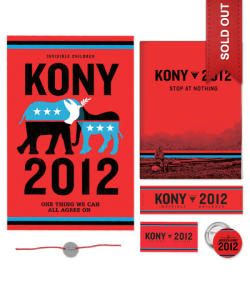
    The video goads buying Invisible Children’s products to “make Kony famous.” The ‘Kony 2012 Action Kit’ is $30 and comes with “Everything you’ll need to take part in our KONY 2012 campaign,” according to the online store. What’s more, “People will think you’re an advocate of awesome.” Awesome. Moreover, the Kony bracelet is dubbed as the “the ultimate accessory” and the model in the image is black, which is significant since most Ugandans couldn’t afford a $10 bracelet, and most people in the video on the “activist” side weren’t people of color. Both products are sold out.

    In 2012, recent UC Berkeley Business Administration graduate Rosalind Chu expressed her internal back-and-forth debate when deciding what career to pursue. In a post called “Excess, wealth, and materialism and how that fits into a career in social enterprise,” she wrote: “society — American society especially – breeds a culture of excess, consumption, and materialism. We are bombarded daily with new products or new ‘somethings,’ and are constantly reminded of how awesome it must be to be rich and wealthy.”

    But are the problems of consumerism exempt from social business? Of course not, but what would an ideal version “conscious consumerism” even look like?

    Consumption – conspicuous or not – must slow right down in order to make up for the dirt in our air, our oceans and our lives… I mean, ideally, the story might go like so: if I need (or, okay, really want) to buy a new lipstick/t-shirt/pair of shoes, I’ll opt for buying the product from an ethical producer rather than from a corporate giant with opaque production practices. But maybe, really, I’ll get both, but I’ll feel better for having also chosen the former.

    Environmentalist, activist and writer George Monbiot said that “[g]reen consumerism has been a catastrophic mistake.” He argued that cause-conscious campaigns – whether hybrid cars or poverty-alleviating shoes – draw in people’s self-interest in that those products will help to beef up your social status. Furthermore, he emphasized the need to crusade for our values rather than conforming to the status quo, an apathetic politically hollow atmosphere. In essence: structural change is needed to mitigate the mess we’re all in.

    While I push for the accessibility of fairly produced products, I just can’t wrap my head around buying yet another thing I don’t need, bought from the convenience of my sweatshop-produced MacBook. But, too often, it comes down to the question of “What’s worse?”

  • 1 to 1 models: are they a social business?

    By Stephen King, Founder at SocialBusiness.org

    Popularized by Tom Shoes, the 1 to 1 business model is when the consumer buys 1, the company gives 1 to those in need for free. This has become more and more popular over the last few years for any product or service within the price range of $20-100. The likely first version of this was the Aravind eye institute, who has being giving cataract eye surgery for paying customers through one door, and the same surgery for free through another – they have been doing this for over 40 years.

    The business model is popular in part because of the elegant in its simplicity. For the entrepreneur it is very easy to understand the concept, write your business plan and even now point to successful examples to more easily secure funding. It is also a great story to attract talented employees, that might just work for less than the equivalent job at another similar product company. The marketing is also very straightforward and compelling; buy one of these, and I will give one to someone who cannot afford them. If the product is of the same quality, and about the same price, then you will convert consumers. This has been true of the Fair Trade coffee movement in the past, get the products to be the same priced with equal quality and the consumer will switch over to the more socially minded product.

    It all sounds good, and these companies are doing great work. But are they really a social business? Is this not the same as giving away some of your profits to charity? What happened if Dell computers gave 1 computer away for every computer bought to someone disadvantaged?

    The definition of social business is widely contested; let’s make an assumption that it is about the company doing something that is socially and environmentally beneficial and continues to do this through earning revenue by operating its service or selling its product. If we use that as the basis, does it qualify? The business helps people without shoes, get shoes – that is good. It does it in a sustainable manner through earned revenue from selling a pair to other people. You could ask where are the materials sourced from, and whether this is an environmentally damaging company, although that is covered at least by TOM’s shoes. Sounds pretty good to me, in particular because as long as TOM continues to sell shoes to customers, we know another customer will get a pair; and I also like how easy it is for me to audit whether or not the company is keeping to its promise of doing good. My belief is that the 1 to 1 model is a social business, the concept of giving a free ‘1’ away with the buying of ‘1’ is intrinsic to the business model.

    And this then takes us back to doing this on a larger scale, and the case of Dell computers. Large companies are having a really tough time lately, as they are not seen to be able to achieve any good, and if they try we are generally suspicious. If Dell or any of these large companies started doing what TOM’s shoes is doing the world would be a much better place. Alongside of the remarkable amount of technology that would now be in the hands of those that could not afford it, I am positive that Dell would learn a lot about how to innovate in order to deliver on this promise. Imagine a computer company that could really give one away every time you bought one, that would be a remarkable offering that would grab the market.

    We need to focus on the improvement from where we are currently and then look to critique constructively on how we can move forward. If more people were to buy TOM’s shoes the world would be better. And in the long-term it might be even better for the recipients of TOM’S shoes to be in a position to afford their own shoes, as they would have a job and are able to take care of themselves. A pair of shoes helps in many ways, and they are hugely valued, although it is not boosting the local economy in the same way that jobs can support independence and reduce the need to rely on aid. This is the longer-term goal, and we will get there, with 1:1 companies now in many markets around the world.

  • Wait — which kind of social business?

    By Bianca Bartz, Editor in Chief of SocialBusiness.org

    When I tell people I write about social business, most people ask “what’s that?”

    A few know I write about businesses striving to make profit to further a social cause, but a good chunk think that I write about businesses that use social media. Although they’re wrong about what we do, it’s a fair assumption. Here’s why:

    Particularly in the last year, the term “social business” has been widely used to describe businesses that regularly integrate social media into their business practices. Makes sense.

    ImageBut prior to that, most online references to “social business” were connected to the ideas of Nobel Peace Prize winner Muhammad Yunus. The “Banker to the Poor,” as he’s often referred to, started Grameen Bank, which began offering micro loans in India in the early 80s. Today versions of the model are found in 100+ countries, all geared at helping entrepreneurs launch businesses so they can lift themselves out of poverty and stimulate their economies.

    Professor Yunus helped bring the term “social business” into popularity after publishing the book Creating a World Without Poverty: Social Business and the Future Of Capitalism in 2007. In a June 2010 Forbes interview, he defined it as such:

    I define social business as a non-loss, non-dividend company dedicated entirely to achieve a social goal. All profits, or “surplus revenue,” is ploughed back into the venture for expansion and improvement. In social business, the investor gets his or her investment money back over time, but never receives dividend beyond that amount.

    Our definition is similar. (You can read it here.) Like Yunus, we love the idea that, unlike charities that have to work with low overheads, have little budget for innovation and expansion and that rely completely on fundraising, social businesses are self-sustaining and have the opportunity to grow exponentially.

    As Yunus said to Forbes, “A charity dollar has one life; a social business dollar has endless lives!” 

    Social Business: Social Media vs Social Enterprise

    ImageBut back to the confusion. Last fall we noticed the term “social business” gain traction online, particularly on Twitter, and soon after in blog posts. Unfortunately, it wasn’t because more people were talking about using business for good. It was around the time IBM came out with a big social business campaign focused on making businesses more social online with their customers. Then we read about the Social Business Forum, based on the same concept. Shortly after, Fast Company wrote an article based on IBM’s initiative, and interviewed Ethan McCarty, IBM’s Senior Manager of Digital and Social Strategy. Here’s how Ethan defined social business:

    Social media is about media and people, which is one dimension of the overall world of business. With social business you start to look at the way people are interacting in digital experiences and apply the insights derived to a wide variety of different business processes.

    Others started adopting the term faster than we could track, and we were suddenly unable to monitor online references to “our” version of social business anymore. Dang. Frustrated that the term was being diluted and losing context, and passionate about clarifying the difference, our community manager, Tia, pitched Fast Company on an article detailing the growing confusion. Unfortunately, we still haven’t heard back. That’s OK though. We’re defining it now.

    Social Business: How it’s Perceived Online

    Not to get too nerdy, but I wanted to show you an example of how search terms — and, accordingly, online perception — pertaining to “social business” have switched largely from references to Yunus’ type of social business to IBM’s. I took screenshots from the top news results in the US for “social business” in 2011, and the same for “social business” in 2008.

    In 2011, only the last result pertained to social enterprise, the result were social media focused.

    In 2008, there were few results, but all were about social enterprise.

    At the end of the day, I love both types of social business and work in both industries. In fact, we’ve merged them at SocialBusiness.org, using our Facebook, Twitter, LinkedIn, Google+ and even Pinterest to help promote purpose-focused businesses. I just wanted to clarify the difference 🙂

  • Do intentions matter?

    By Editor of SocialBusiness.org

    Social businesses, like charities, often have lofty ideals about changing the world through their mission, message and impact. Press material, websites and Twitter bios are often swarmed with rhetoric like “changing the world,” “making a difference” and “join the movement.” Regardless of how the overuse of these sayings can prove meaningless, mission statements should reflect the intentions of the organization itself. In a recent interview with Sissy Rooney, the founder of the UK-based social enterprise Street Style Surgery, she urged aspiring social entrepreneurs to write their mission statements right off the bat. She had hers posted above the computer from which we Skyped. “We don’t have an obligation to solve America’s problems,” a current Apple executive told the New York Times in January in a piece about American job loss and foreign manufacturing. “Our only obligation is making the best product possible.” That speaks mountains. While I would consider the “best product” one that takes in mind problems in its home country, that is, unemployment, traditional corporations, of course, don’t operate like that. Of course, the very idea of a “social business” conjures up ideas of good intentions—no matter what.  The quote speaks to the notion that a sentence or two can encapsulate how the main goal, or “obligation,” of a business is engrained into day-to-day operations. Because they’re unquantifiable, how do you judge the mostly good intentions of social businesses and social enterprises? Do we even need to or is it impact that’s more important? I’ve been writing about social businesses and working for SocialBusiness.org for over a year now, but even before then, I’d been skeptical about the relationship between intentions—whether good or bad—and outcome. As a wide-eyed undergraduate in international development studies, I was full of good intentions and I thought that my zealousness would be reflected in everything I studied. But regardless of intentions, bad things happen. Unintentionally or not. Also, intentions portrayed to those outside of the organization aren’t necessarily the intentions that dictate business behavior. How and why do social businesses negotiate intentions into their business models and daily practices? Let’s take a look at TOMS, a socially driven for-profit, and a company that some consider paramount when it comes to the successful integration of money and meaning. I’ll use TOMS as an example because the brand is exceptionally popular, especially among students. The idea for TOMS started when Blake Mycoskie was traveling and met Argentinian children with no shoes. Since then, he’s been providing shoes for children all over the world through, well, selling. Now, I’ll save my complaints of consumerism for another piece but here’s one way to think about it: Is buying a pair of shoes that donates a pair better than buying a pair of shoes that doesn’t? And what’s the alternative? There are countless criticisms of TOMS. In 2010, GoodIntents.org posted a succinct point-form criticism called “TOMS Shoes: Good Marketing – Bad Aid.” In a similar vein, Kelsey Timmerman of Where Am I Wearing? points out that TOMS products are made in China, and thus don’t create jobs for local communities. A free pair of shoes won’t last long. Yes, it means children are in a better position to attend school, but the impact of a well-paying job, water infrastructure or clean and reliable energy would undoubtedly have more of an impact. “Yes, someone giving you a pair of shoes would sure be nice if you didn’t have a pair,” wrotes Timmerman in a blog post. “But a job that allows parents to send their kids to school could change your family tree forever.” Timmerman uses the example of SoleRebels, a company SocialBusiness.org covered in 2011:

    Let’s say that every worker at SoleRebels has five kids (the fertility rate of Ethiopia). The workers send all five kids to school and since they have an education they don’t grow up to be shoemakers. They do something that pays better and they send their five kids to school. A job, a good job, has an exponential impact. Within a few generations the 100 jobs at SoleRebels have impacted tens of thousands of people. Within six generations, the jobs have impacted millions. Now imagine if SoleRebels sold as many shoes as TOMS. This isn’t just life-changing stuff, this is possibly country-changing, poverty-fighting stuff.

    The YouTube video “A Day Without Dignity” spun off of the TOMS “A Day Without Shoes” publicity stunt is a dig-deep take on how donations create a tremendous amount job loss. According to the video, which was put on by GoodIntents.org, handing out free goods out-competes local markets. What’s more, used-clothing imports to Africa caused 50% of the increase in unemployment between 1981 to 2000. This isn’t to say that TOMS didn’t (and doesn’t) have good intentions, for the business, for the people who receive the donations, and for the world. But intentions don’t predict outcome or prevail over the messiness of complexities like local government, natural disasters, corruption, etc. It’s unscrupulous to ignore mutated results even when someone is sincerely trying to “do the right thing.” Intentions, too, shift. They transform and they mutate. Clearly, good intentions aren’t enough to create on-the-ground impact. What’s necessary is, yes, purpose, but also checks and balances, transparency and the willingness to admit, perhaps, that your outcomes have overpowered your intentions. What are the needs of the community you are serving? Have you asked them? Have you considered all the parties involved? Who and what will be affected? It’s about looking beyond mere “giving” and toward partnership. Peppering your messaging with intention-revealing buzz words can have an impact on engaging an audience that might not otherwise care about your cause, however, there runs a risk of losing integrity. And integrity in social business, by the nature of the field, is crucial to creating an image with the public, doing well financially and serving local communities, which should have been the point of creating the company in the first place.